Grammar Basics
Subject–Verb Agreement Exercises with Answers
· 4 min read
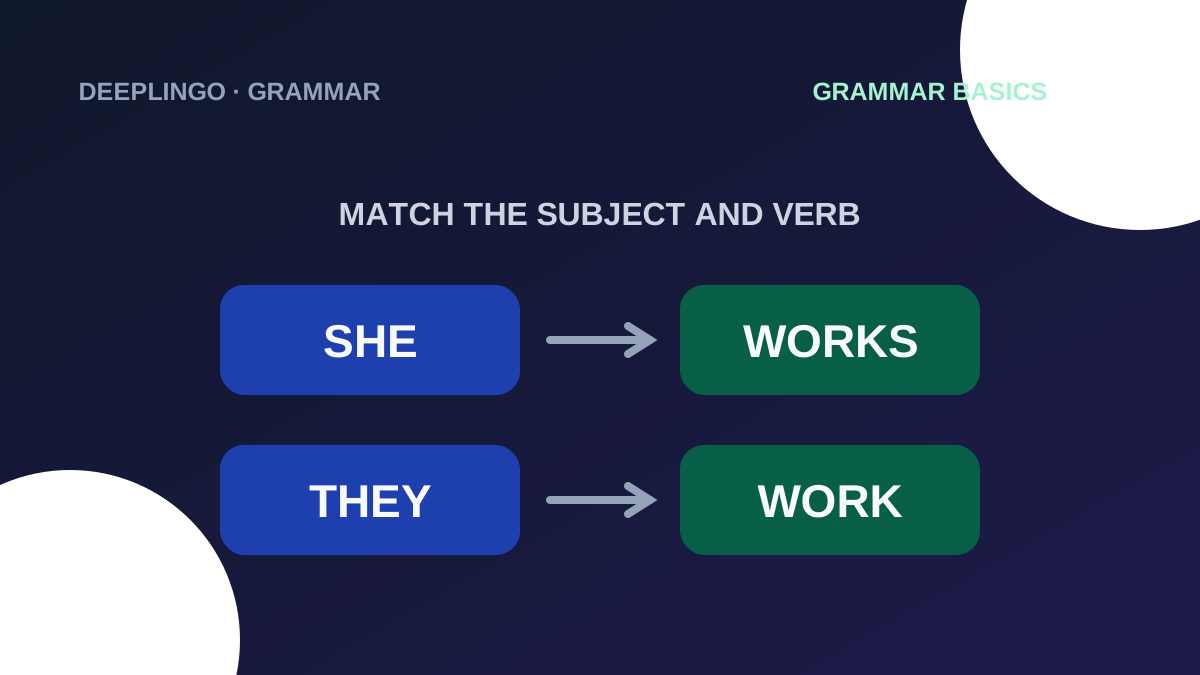
Choose the verb that agrees with the subject, rather than a nearby noun. In the present simple, a third-person singular subject normally takes an -s form, while a plural subject takes the base form. Be and have need their own forms.
Find the head of the subject
In “The box of pencils is on the desk,” box is the head of the subject phrase. Pencils belongs to the phrase of pencils; it does not make the whole subject plural. This matters when a long phrase comes between the subject and verb.
The box of pencils is on the desk.
💡 The head word box is singular.
My friends work nearby.
💡 Friends is plural.
My friend works nearby.
💡 A singular noun subject follows the same agreement pattern as he or she.
Check the verb form
| Subject | Be | Have | Ordinary present verb |
|---|---|---|---|
| I | am | have | work |
| you/we/they | are | have | work |
| he/she/it; one friend | is | has | works |
In an ordinary present-simple negative, doesn't pairs with a third-person singular subject and don't with I, you, we and they. After does or doesn't, use the base verb: “She doesn't work on Fridays.” The -s belongs on does, not on work as well.
Expressions that can mislead you
Everyone, everybody, each and someone normally take a singular verb. Two distinct people joined by and normally take a plural verb. Uncountable nouns such as information also normally take singular agreement. Do not decide just by counting how many people a word might refer to: everyone can refer to many people but still takes is.
Some collective nouns allow different agreement patterns in different varieties of English. This quiz avoids those disputed choices. The aim is to practise clear agreement, not to mark a valid dialect choice wrong.
Use agreement in speaking
Read a completed answer aloud, then replace the subject with another one. “My friend works” becomes “My friends work.” This helps you notice the sound change while retaining the same meaning and sentence pattern.
Practice: 12 questions
Try all twelve before reading the answers. Use the context in each sentence, not just a single signal word.
1. The list of ingredients ___ on the counter. Choose is or are.
2. My cousins ___ nearby. Choose lives or live.
3. Each student ___ a workbook. Choose has or have.
4. The children ___ ready. Choose is or are.
5. I ___ interested in the course. Choose am or are.
6. She ___ work on Sundays. Choose don't or doesn't.
7. Everyone in these rooms ___ an ID card. Choose needs or need.
8. The information on these pages ___ useful. Choose is or are.
9. Tom and Aisha ___ the project together. Choose manages or manage.
10. My brother ___ two languages. Choose speaks or speak.
11. You ___ welcome to join us. Choose is or are.
12. Correct the whole verb phrase: “He doesn't likes coffee.”
Answers and explanations
1. is
💡 List is the singular head; ingredients does not control agreement.
2. live
💡 Cousins is a plural subject.
3. has
💡 Each student takes singular agreement.
4. are
💡 Children is plural, despite lacking a regular -s ending.
5. am
💡 I uses the form am.
6. doesn't
💡 She takes doesn't; work remains the base form.
7. needs
💡 Everyone takes singular agreement; rooms belongs to a modifying phrase.
8. is
💡 Information is uncountable and takes singular agreement here.
9. manage
💡 Two distinct people joined by and form a plural subject.
10. speaks
💡 My brother is third-person singular.
11. are
💡 You takes are for either one person or several people.
12. He doesn't like coffee.
💡 After doesn't, use the base form like.
Do only he, she and it take -s?
No. A singular third-person noun phrase such as my teacher also takes the -s form: my teacher explains.
Is the closest noun always the subject?
No. A nearby noun may belong to a modifying phrase. Find the head of the whole subject phrase.
Keep learning
Review the subject–verb agreement rules, sentence parts, pronouns and present simple.
Grammar reference: Cambridge on subject–verb agreement. The lesson explanations and practice questions are original.
Practice in the 30 Days English Challenge: Day 23: Each, Either and Neither: Understand the Difference