Basics
Parts of a Sentence: Subject, Verb, Object Explained Simply
· 4 min read · Updated
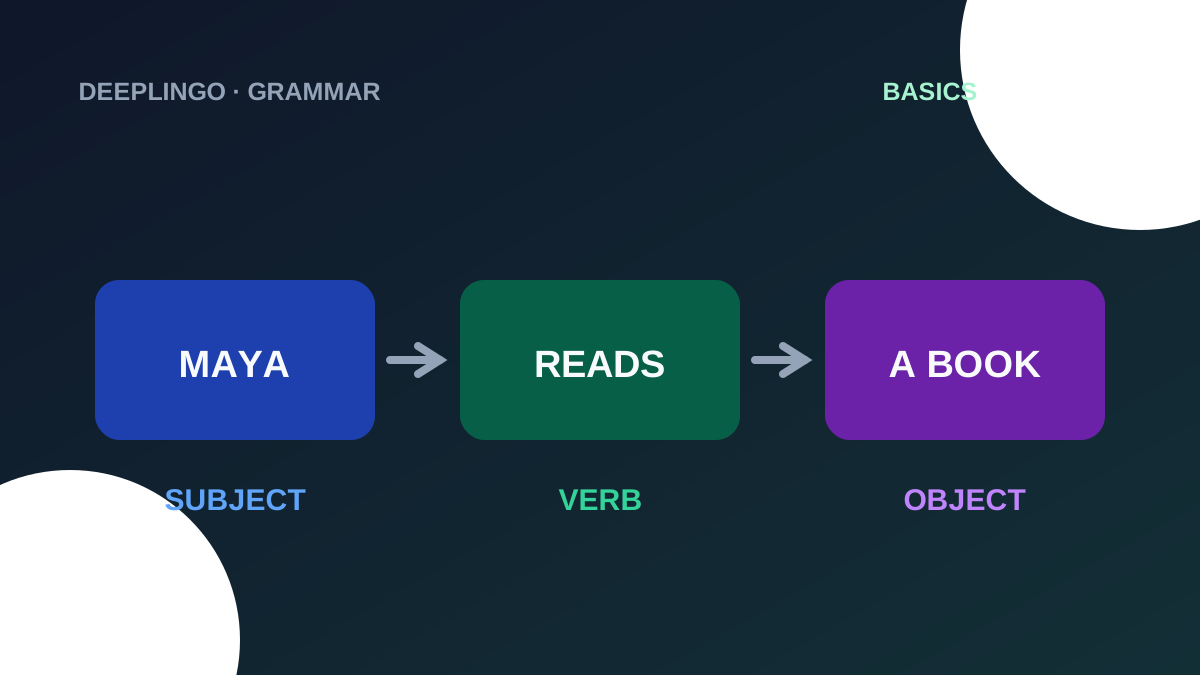
A complete English clause normally has a subject and a verb. Some verbs take an object; others need no object or use a complement.
Why Learn Sentence Basics First?
Before learning grammar rules, you need to understand how English sentences work. Every English sentence is made using simple building blocks. Once you know these blocks, everything else becomes easier!
Think of it like building with LEGO. You need to know the basic pieces before you can build something amazing. 🧱
The Three Main Parts
A common basic sentence pattern has these three parts, although an object is not always needed:
1. Subject - WHO or WHAT does the action
2. Verb - The ACTION word (what happens)
3. Object - WHO or WHAT receives the action
Understanding the Subject
The subject is the person or thing doing something. Ask yourself: "Who is doing this?" That's the subject!
I eat rice.
💡 Who eats? → I (subject)
She reads a book.
💡 Who reads? → She (subject)
The boy opens the door.
💡 Who opens? → The boy (subject)
My mother cooks food.
💡 Who cooks? → My mother (subject)
The dog runs fast.
💡 What runs? → The dog (subject)
We play cricket.
💡 Who plays? → We (subject)
The teacher explains the lesson.
💡 Who explains? → The teacher (subject)
Birds fly in the sky.
💡 What flies? → Birds (subject)
Understanding the Verb
The verb can express an action, event or state. An ordinary complete clause needs a verb, even when nobody is doing an action: “She is happy.”
I eat rice.
💡 What do I do? → eat (verb)
She reads a book.
💡 What does she do? → reads (verb)
He plays football.
💡 What does he do? → plays (verb)
They watch TV.
💡 What do they do? → watch (verb)
We drink water.
💡 What do we do? → drink (verb)
The cat sleeps on the bed.
💡 What does the cat do? → sleeps (verb)
The children laugh loudly.
💡 What do the children do? → laugh (verb)
My friend helps me.
💡 What does my friend do? → helps (verb)
Understanding the Object
The object receives the action. Ask yourself: "What is being affected?" That's the object! Not all sentences have objects.
I eat rice.
💡 What do I eat? → rice (object)
She reads a book.
💡 What does she read? → a book (object)
He plays football.
💡 What does he play? → football (object)
They watch TV.
💡 What do they watch? → TV (object)
We drink water.
💡 What do we drink? → water (object)
The boy opens the door.
💡 What does the boy open? → the door (object)
I love my family.
💡 What do I love? → my family (object)
She writes a letter.
💡 What does she write? → a letter (object)
Putting It All Together
Now let's see how Subject + Verb + Object work together:
I eat rice.
💡 Subject + Verb + Object
She reads books.
💡 Subject + Verb + Object
The boy kicks the ball.
💡 Subject + Verb + Object
My mother makes tea.
💡 Subject + Verb + Object
The teacher teaches English.
💡 Subject + Verb + Object
They play games.
💡 Subject + Verb + Object
We love our country.
💡 Subject + Verb + Object
The dog eats food.
💡 Subject + Verb + Object
Sentences Without Objects
Some sentences don't need an object. They are still complete with just Subject + Verb:
I sleep.
💡 Complete sentence - no object needed
She laughs.
💡 Complete sentence - no object needed
The baby cries.
💡 Complete sentence - no object needed
Birds fly.
💡 Complete sentence - no object needed
The sun shines.
💡 Complete sentence - no object needed
He runs.
💡 Complete sentence - no object needed
Objects are optional; complements are different
“Birds fly” has a subject and a verb, with no object. “Lena is calm” has a subject, linking verb and subject complement: calm describes Lena, rather than receiving an action. “Close the door” is an imperative with an understood subject, you.
Quick practice
1. Identify the subject in “The small dog barked.”
2. Does “The baby slept” need an object?
3. Is happy an object in “Maya is happy”?
4. What subject is understood in “Please wait”?
Practice answers and explanations
1. The small dog
💡 The complete noun phrase is the subject.
2. No
💡 Slept is intransitive in this sentence.
3. No
💡 Happy is a subject complement describing Maya.
4. You
💡 Imperatives usually leave you unspoken.
Continue learning
Subjects and Verbs: How They Work Together · English Word Order: Rules and Examples
Practice in the 30 Days English Challenge: Day 3: Object Pronouns: When to Use Me, Him, Her and Them · Day 6: Relative Pronouns: Connect Ideas with Who, Which and That · Day 27: Active and Passive Voice: Rules, Examples and Practice