Grammar Basics
Some and Any: Rules, Exceptions and Practice
· 4 min read
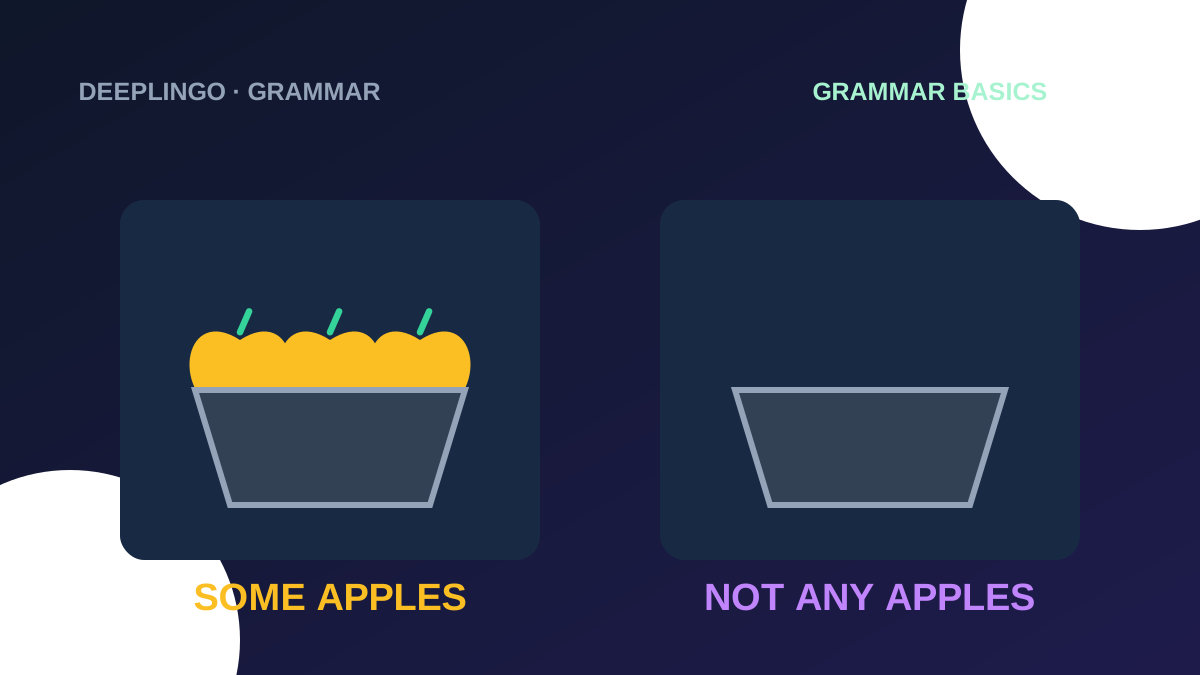
Use some for an unspecified amount or number in many positive statements. Use any in many negatives and neutral questions. This is a starting pattern, not a rule that every question must use any.
The basic pattern
| Meaning | Example | Why |
|---|---|---|
| Positive quantity | We bought some apples. | An unspecified number |
| Negative quantity | We didn't buy any apples. | No apples were bought |
| Neutral question | Did you buy any apples? | The answer is open |
Both words work with plural countable nouns and uncountable nouns: some tickets, any tickets, some rice, any rice. For a single nonspecific countable item, a or an is often appropriate: “I need a ticket.” Do not use the quantity pattern to create an ordinary plural of an uncountable noun such as information.
We have some fresh bread.
💡 Some indicates an unspecified amount.
We don't have any bread.
💡 Any is the usual choice after the negative verb here.
Do you have any questions?
💡 A neutral question asks whether questions exist.
Offers and requests often use some
A speaker can use some in a question when offering something or asking for an amount they hope is available: “Would you like some soup?” and “Could I have some water?” The sentence is a question, but its purpose differs from a neutral check. Any can still be grammatical in other contexts; decide what the speaker means rather than treating the punctuation as a rule.
Any can mean whichever you choose
In “Choose any seat,” any expresses unrestricted choice. This use can appear in a positive instruction and with a singular countable noun. “Any student can apply” means every student is eligible, rather than referring to an unspecified small group.
Avoid double negatives in standard writing
Use “We don't have any tickets” or “We have no tickets.” Standard edited English normally avoids combining don't with no to express this meaning. Regional and conversational patterns vary, but the two standard alternatives are useful for learners.
Common mistakes
❌ I don't need some help.
✅ I don't need any help.
For the intended ordinary meaning of no help, any is the usual choice.
❌ I need an information.
✅ I need some information.
Information is normally uncountable; a piece of information is a countable unit.
Practice: 12 questions
Try all twelve before reading the answers. Use the context in each sentence, not just a single signal word.
1. Choose the usual neutral form: “Do you have ___ questions?” (some/any)
2. Choose the usual positive form: “I bought ___ bananas.” (some/any)
3. Choose the usual negative form: “We don't have ___ rice.” (some/any)
4. Complete a friendly offer: “Would you like ___ tea?” (some/any)
5. Complete a polite request for an amount: “Could I have ___ water?” (some/any)
6. Complete the unrestricted-choice instruction: “Take ___ card you like.” (some/any)
7. Choose the usual positive form: “There is ___ milk in the fridge.” (some/any)
8. Choose the usual negative form: “She hasn't received ___ replies.” (some/any)
9. Complete the neutral availability question: “Are there ___ seats left?” (some/any)
10. Complete the open eligibility statement: “___ learner may join; there are no entry requirements.” (Some/Any)
11. Rewrite in standard English with any: “There are no biscuits left.”
12. Is any a neutral quantity question or free choice in “You can call me at any time”?
Answers and explanations
1. any
💡 The question neutrally checks whether there are questions.
2. some
💡 This is a positive statement about an unspecified quantity.
3. any
💡 The negative statement says there is no rice.
4. some
💡 An offer commonly uses some.
5. some
💡 Some is usual when politely requesting an amount.
6. any
💡 The person may choose whichever card they want.
7. some
💡 Milk is uncountable, and the statement is positive.
8. any
💡 The verb is negative and replies is plural.
9. any
💡 This is a neutral availability check.
10. Any
💡 Every learner is eligible, without restriction.
11. There aren't any biscuits left.
💡 A negative verb plus any expresses the same ordinary meaning as no biscuits.
12. Free choice
💡 Any time means whichever time is suitable.
Can some appear in a question?
Yes. Offers and requests commonly use some, and a question may also use it when the speaker expects a positive answer.
Can any appear in a positive sentence?
Yes. In its free-choice meaning, any can appear in positive statements and instructions.
Keep learning
Compare much and many, review countability, and study a, an and the.
Grammar reference: British Council on quantifiers. The lesson explanations and practice questions are original.
Practice in the 30 Days English Challenge: Day 16: Indefinite Pronouns: Someone, Anyone, Everyone and Nobody · Day 30: Countable and Uncountable Nouns: Choose the Right Quantity