Basics
Small English Words That Change the Meaning
· 4 min read · Updated
Articles, prepositions and other small words can change a sentence’s meaning. Learn them in phrases with a clear context.
Why Small Words Matter
In English, some very small words can completely change the meaning of a sentence. These tiny words might seem unimportant, but they are actually very powerful!
Let's learn these small but mighty words! 💪
A vs AN vs THE
These three small words are called articles. They come before nouns.
A / AN = any one, not specific (first time mentioning)
THE = specific one, we know which one
I saw a dog.
💡 Any dog, not specific (first mention)
The dog was brown.
💡 That same dog I just mentioned (specific)
She ate an apple.
💡 Any apple (first mention)
The apple was sweet.
💡 That specific apple she ate
I need a pen.
💡 Any pen will work
Give me the pen.
💡 That specific pen (you know which one)
When to use A vs AN:
A book, a cat, a house
💡 A before consonant sounds (b, c, h...)
An apple, an egg, an umbrella
💡 AN before vowel sounds (a, e, i, o, u)
An hour
💡 AN because "hour" sounds like "our" (h is silent)
A university
💡 A because it sounds like "yoo-niversity"
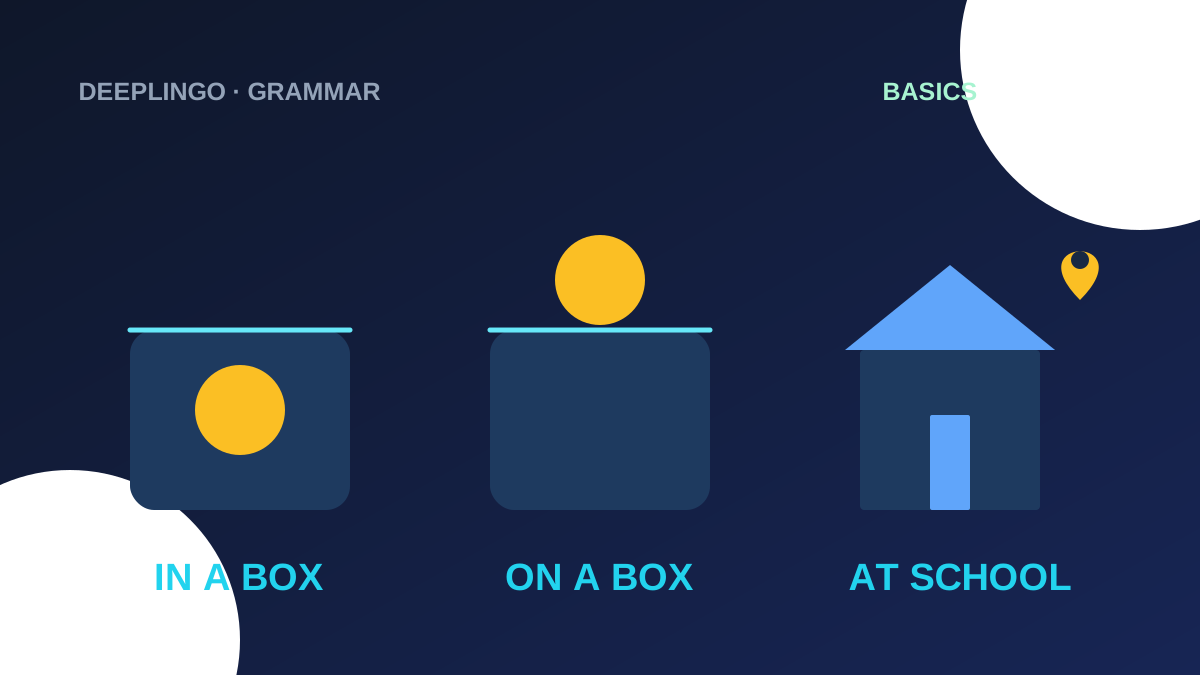
IN vs ON vs AT (Place)
These words tell us WHERE something is. They seem similar but have different uses!
| Word | Use For | Examples |
|---|---|---|
| IN | Inside enclosed spaces | in the room, in the box, in India |
| ON | Surface / touching | on the table, on the wall, on the floor |
| AT | Specific point / location | at the door, at school, at home |
The book is in the bag.
💡 Inside the bag (enclosed)
The book is on the table.
💡 On top of the table (surface)
I am at the bus stop.
💡 At a specific location (point)
She lives in Delhi.
💡 Inside the city
The picture is on the wall.
💡 Touching the wall surface
Meet me at the park.
💡 At a meeting point
See how they change meaning:
She is in the school.
💡 Inside the school building
She is at school.
💡 At school (studying, not necessarily inside)
The cat is in the car.
💡 Inside the car
The cat is on the car.
💡 On top of the car
IN vs ON vs AT (Time)
The same words are used for TIME too, but differently!
| Word | Use For | Examples |
|---|---|---|
| IN | Months, years, seasons, parts of day | in January, in 2024, in summer, in the morning |
| ON | Days, dates | on Monday, on 15th August, on my birthday |
| AT | Specific times | at 5 PM, at noon, at midnight, at night |
I wake up at 6 AM.
💡 Specific time
I exercise in the morning.
💡 Part of day
I rest on Sunday.
💡 Day of week
She was born in 1995.
💡 Year
The party is on Saturday.
💡 Day
Come at 7 o'clock.
💡 Specific time
We travel in summer.
💡 Season
My birthday is on March 5th.
💡 Date
TO vs FOR
These two words often confuse learners. Let's see the difference:
TO = direction, destination, or receiver
FOR = purpose, benefit, or duration
I am going to school.
💡 Destination
This gift is for you.
💡 Benefit/receiver
I gave the book to her.
💡 Receiver of action
I bought flowers for her.
💡 Benefit/purpose
I walked to the park.
💡 Direction
I waited for 2 hours.
💡 Duration
Talk to me.
💡 Direction of communication
I work for a company.
💡 Who benefits from work
WITH vs BY
WITH = using a tool, or together with someone
BY = method, or near something
I write with a pen.
💡 Using a pen (tool)
I came by bus.
💡 Method of transport
I live with my parents.
💡 Together with
The house is by the river.
💡 Near the river
Cut it with a knife.
💡 Using a knife
I paid by card.
💡 Method of payment
She came with her friend.
💡 Together with
Sit by me.
💡 Near/next to me
Common Mistakes
❌ I am in home.
✅ I am at home.
💡 We say "at home" not "in home"
❌ See you in Monday.
✅ See you on Monday.
💡 Days use ON
❌ I go to school with bus.
✅ I go to school by bus.
💡 Transport method uses BY
❌ This is a umbrella.
✅ This is an umbrella.
💡 Vowel sound needs AN
❌ I wake up in 7 AM.
✅ I wake up at 7 AM.
💡 Specific time uses AT
See How Meaning Changes
Look at these sentences. Same words, different small word = different meaning!
I looked at her.
💡 I directed my eyes toward her
I looked for her.
💡 I tried to find her
I looked after her.
💡 I took care of her
He ran to the door.
💡 Direction: toward the door
He ran into the door.
💡 He crashed/hit the door
He ran through the door.
💡 He went through the doorway
Continue learning
A, An and The: English Article Rules · In, On and At: English Prepositions
Practice in the 30 Days English Challenge: Day 14: Prepositions of Place: In, On, Beside and Next To