Tenses
Present Perfect vs Past Simple: Examples and Practice
· 4 min read
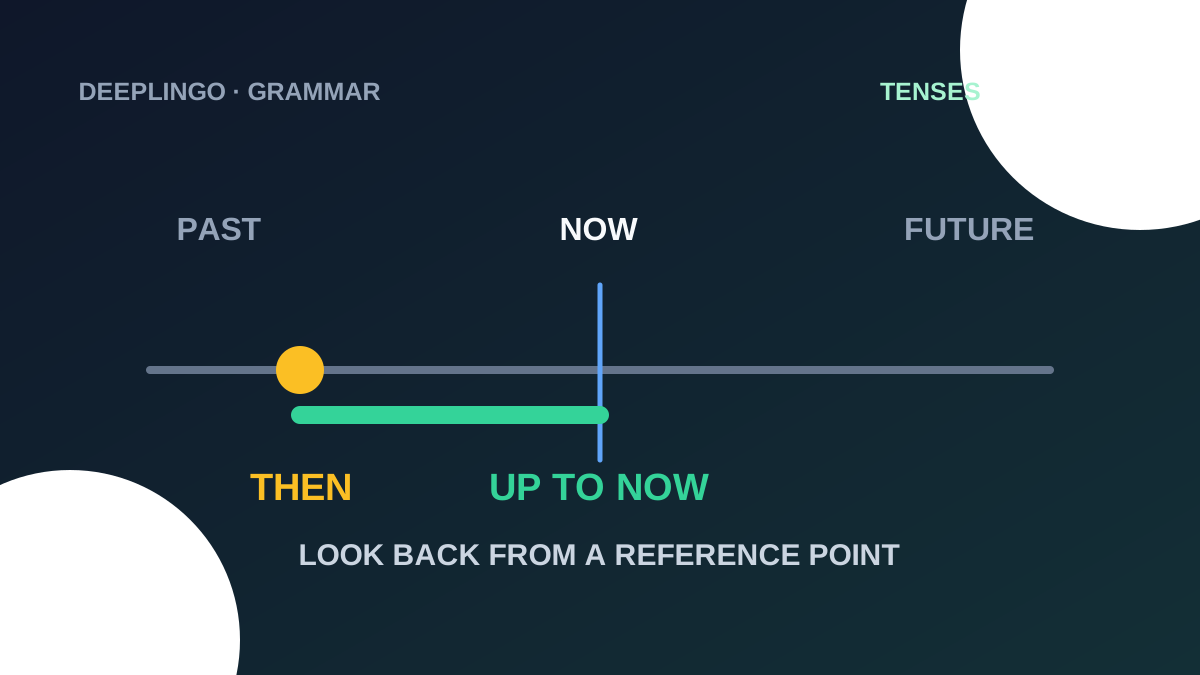
Use the past simple to place an event in a finished past period. Use the present perfect to look back from now at experience, a current result or a period continuing up to now. Both can describe completed actions; the speaker's time perspective matters.
Compare the time perspective
| Tense | Pattern | Example |
|---|---|---|
| Past simple | past form / did + base form | I visited Oslo in 2023. |
| Present perfect | have/has + past participle | I have visited Oslo twice. |
The first example names a finished past time. The second counts experience up to now without placing the visits in a particular finished period. “Completed” alone is therefore not a reliable decision rule.
Leah lost her pass yesterday.
💡 Yesterday places the event in a finished past period.
Leah has lost her pass, so she cannot enter now.
💡 The present perfect highlights a current result.
I have known Ben for years.
💡 The relationship continues now.
Choose the tense before the signal word
Yesterday, last week and a finished date normally go with the past simple when they locate the event. Today and this week do not mechanically require the present perfect. If the speaker treats the relevant part of the day as finished, the past simple can be suitable. Context tells the reader which perspective is intended.
For example, someone describing their day so far might say “I have answered six messages today.” In the evening, describing an earlier meeting, they might say “I answered the client's question at nine.” The date can be the same, but the framing is different.
Form questions and negatives
For ordinary past-simple lexical verbs, use did or didn't with the base form: “Did she call?” and “She didn't call.” Be is different: “Was she ready?” For the present perfect, put have or has before the subject in a question: “Has she called?” Use haven't or hasn't for a negative.
Usage varies
American English often uses the past simple with already, just and yet in contexts where British English commonly uses the present perfect. Do not label every such difference an error. In the questions below, explicit time context is provided so the intended answer is clear.
Practice: 12 questions
Try all twelve before reading the answers. Use the context in each sentence, not just a single signal word.
1. Yesterday, I ___ (meet) the new manager. Supply the past simple.
2. I ___ (know) Sara since primary school, and we are still close. Use the present perfect.
3. We ___ (visit) the museum in 2022. Choose the tense and form.
4. My train pass is missing. I ___ (lose) it, so I cannot travel now. Use the present perfect to emphasize the current result.
5. He ___ not ___ (finish) the report yet. Use the present perfect.
6. ___ you ___ (watch) the match last night? Form a past-simple question.
7. She ___ (work) here from 2018 to 2020. She now works elsewhere. Choose the tense.
8. We ___ never ___ (try) surfing in our lives up to now. Use the present perfect.
9. Correct the verb form: “I didn't went to the meeting.”
10. Correct the verb form: “Has she wrote the email?”
11. Two hours ago, the shop ___ (close). Choose the tense.
12. In your life up to now, ___ you ever ___ (ride) a horse? Use the present perfect.
Answers and explanations
1. met
💡 Yesterday locates the meeting in a finished past time.
2. have known
💡 The relationship began in the past and continues now.
3. visited
💡 In 2022 names a finished past period.
4. have lost
💡 This form presents the missing pass as a current result.
5. has not finished
💡 He takes has; finished is the past participle.
6. Did you watch
💡 Did takes the base form watch.
7. worked
💡 The employment period is explicitly finished.
8. have never tried
💡 The sentence describes experience up to the present.
9. I didn't go to the meeting.
💡 Did already carries the past tense; use base-form go.
10. Has she written the email?
💡 The present perfect needs the past participle written.
11. closed
💡 Two hours ago places the event at a finished past time.
12. have you ever ridden
💡 Have precedes you, and ridden is the past participle.
Does present perfect always mean the action is unfinished?
No. It can describe a finished action with a present result, such as a missing pass. A continuing state is another use.
Is today always present perfect?
No. The speaker can view an earlier event today as a finished past event. Choose the tense from the intended time perspective.
Keep learning
Review the past simple, the present perfect and since and for.
Grammar reference: British Council on present perfect. The lesson explanations and practice questions are original.
Practice in the 30 Days English Challenge: Day 20: Perfect Tenses: Present, Past and Future Explained