Advanced Grammar
Gerunds vs Infinitives: When to Use -ing or 'to'
· 5 min read
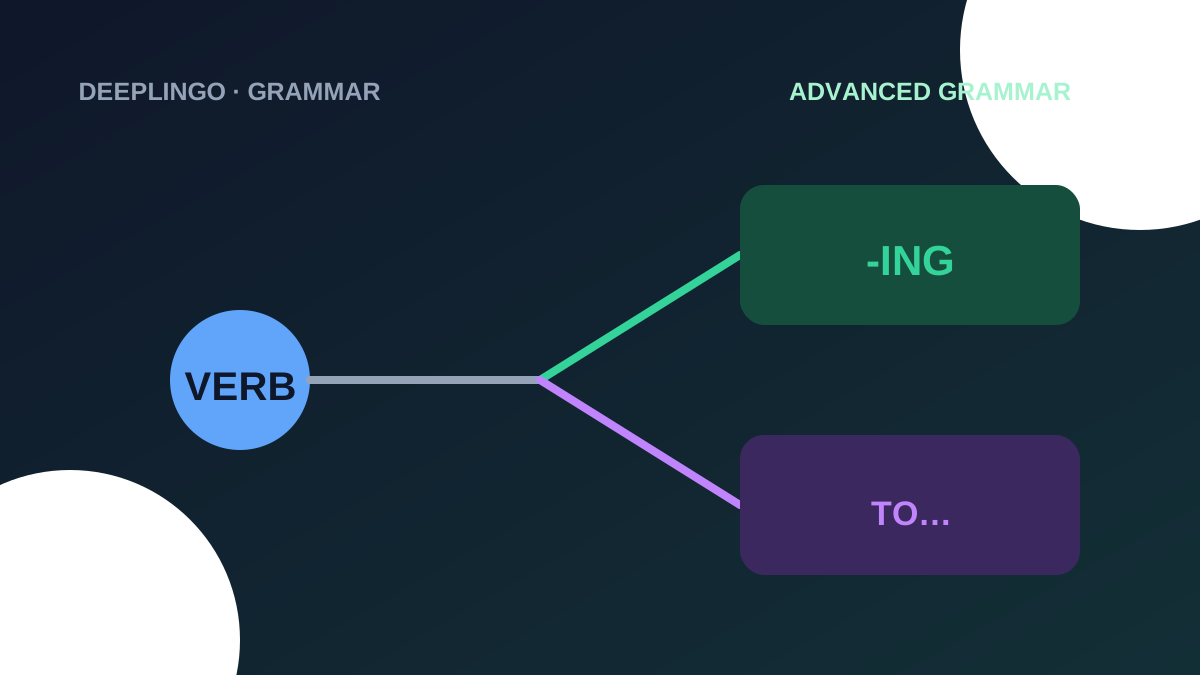
Some verbs take an -ing form, others take a to-infinitive, and some allow both with a change in meaning. Learn the pattern with the verb.
Should you say 'I enjoy swimming' or 'I enjoy to swim'? This guide will end your confusion about gerunds and infinitives! 🏊
What Are Gerunds and Infinitives?
Gerund = verb + -ing (used as a noun). Infinitive = to + base verb.
💡 Gerund as subject
I love
💡 Gerund as object
I want
💡 Infinitive as object
My goal is
💡 Infinitive after "be"
Gerund as Subject
When a verb-action is the subject of a sentence, use the gerund form:
💡 Reading = subject
💡 Swimming = subject
💡 Learning = subject
💡 Cooking = subject
💡 Smoking = subject
Verbs Followed by Gerunds Only (-ing)
These verbs MUST be followed by gerunds. Memorize them!
| Verb | Example | Meaning |
|---|---|---|
| enjoy | I enjoy reading books. | Take pleasure in |
| avoid | She avoids eating junk food. | Stay away from |
| finish | He finished writing the report. | Complete |
| practice | They practice speaking English. | Do repeatedly |
| consider | We considered moving to Canada. | Think about |
| keep | Keep trying! | Continue |
| mind | Do you mind waiting? | Object to |
| suggest | I suggest leaving early. | Recommend |
| miss | I miss seeing my friends. | Feel sad about not doing |
| quit | He quit smoking. | Stop |
| admit | She admitted making a mistake. | Confess |
| deny | He denied stealing the money. | Say it is not true |
❌ I enjoy to read. → ✅ I enjoy reading.
💡 Enjoy + gerund
❌ She avoids to eat sugar. → ✅ She avoids eating sugar.
💡 Avoid + gerund
❌ He finished to write. → ✅ He finished writing.
💡 Finish + gerund
❌ I miss to see you. → ✅ I miss seeing you.
💡 Miss + gerund
Verbs Followed by Infinitives Only (to + verb)
These verbs MUST be followed by infinitives!
| Verb | Example | Meaning |
|---|---|---|
| want | I want to learn guitar. | Desire |
| need | She needs to study more. | Require |
| decide | They decided to stay home. | Choose |
| hope | We hope to see you soon. | Wish for |
| plan | He plans to travel next year. | Intend |
| agree | She agreed to help me. | Say yes |
| refuse | He refused to answer. | Say no |
| learn | I am learning to cook. | Gain skill |
| promise | She promised to call. | Give word |
| expect | They expect to win. | Anticipate |
| offer | He offered to help. | Volunteer |
| seem | She seems to be happy. | Appear |
❌ I want learning. → ✅ I want to learn.
💡 Want + infinitive
❌ She decided staying. → ✅ She decided to stay.
💡 Decide + infinitive
❌ He refused answering. → ✅ He refused to answer.
💡 Refuse + infinitive
❌ They plan traveling. → ✅ They plan to travel.
💡 Plan + infinitive
Verbs That Take Both (with Different Meanings!)
Some verbs can take both, but the meaning changes! This is very important:
STOP:
I stopped smoking.
💡 = I quit the habit of smoking. (No more smoking!)
I stopped to smoke.
💡 = I paused what I was doing in order to have a cigarette.
REMEMBER:
I remember locking the door.
💡 = I have a memory of doing it. (Past action I recall)
I remember to lock the door.
💡 = I don't forget to do it. (Future action I won't forget)
FORGET:
I'll never forget meeting you.
💡 = The memory of meeting you will stay with me.
Don't forget to call me.
💡 = Remember to call me (future action).
TRY:
I tried opening the window.
💡 = I experimented with opening it (to see what happens).
I tried to open the window.
💡 = I attempted but maybe failed (it was difficult).
REGRET:
I regret telling him the truth.
💡 = I'm sorry that I told him. (Past action I regret)
I regret to tell you that you failed.
💡 = I'm sorry to inform you. (Formal announcement)
After Prepositions: ALWAYS Use Gerunds!
This is a golden rule: After any preposition (in, at, for, about, of, without, before, after...), ALWAYS use the gerund!
I am interested in
💡 After preposition "in"
She is good at
💡 After preposition "at"
Thank you for
💡 After preposition "for"
I am tired of
💡 After preposition "of"
He left without
💡 After preposition "without"
Before
💡 After preposition "before"
After
💡 After preposition "after"
I am thinking about
💡 After preposition "about"
Common Expressions with Gerunds
It's no use
💡 Fixed expression
It's worth
💡 Worth + gerund
I can't help
💡 Can't help + gerund = can't stop
I look forward to
💡 Look forward to + gerund
There's no point in
💡 No point in + gerund
Common Mistakes to Avoid
❌ I look forward to meet you. → ✅ I look forward to meeting you.
💡 "To" here is preposition, not infinitive!
❌ I am used to wake up early. → ✅ I am used to waking up early.
💡 "To" is preposition
❌ She suggested to go. → ✅ She suggested going.
💡 Suggest + gerund
❌ I avoid to eat sugar. → ✅ I avoid eating sugar.
💡 Avoid + gerund
Continue learning
In, On and At: English Prepositions · Action and State Verbs: Rules and Examples